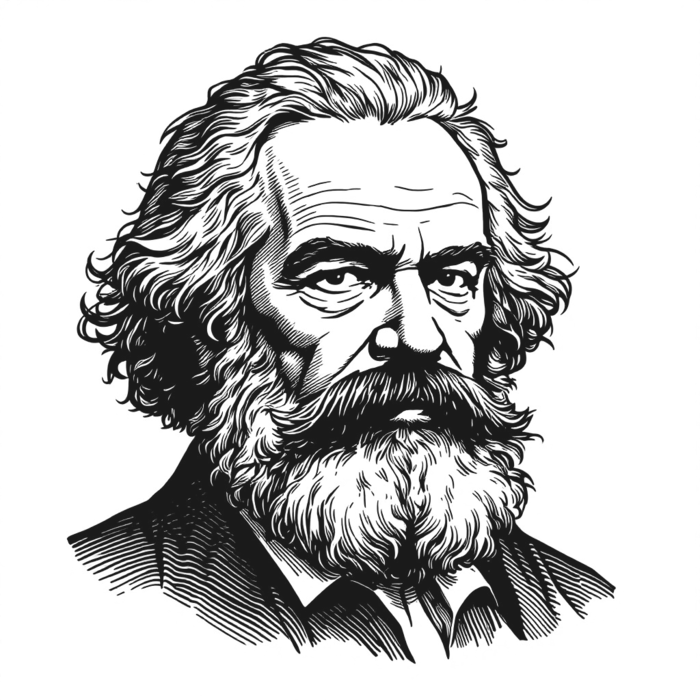
Karl Marx

Karl Marx

1818 – 1883 Modern Era European Forces

Karl Marx (1818–1883) was a German philosopher, economist, historian, and revolutionary socialist whose ideas fundamentally reshaped political thought and world history. Born in Trier, Prussia, he studied law and philosophy at the universities of Bonn and Berlin, where he was influenced by Hegelian dialectics. With Friedrich Engels, he authored The Communist Manifesto (1848), a fiery call for working-class revolution that declared all history to be a history of class struggles. His magnum opus, Das Kapital, provided a comprehensive analysis of capitalism, arguing that the system inherently generates exploitation through the extraction of surplus value from labor. Marx developed the theory of historical materialism, which holds that the economic base of society—the means and relations of production—shapes its political, legal, and cultural superstructure. He predicted that capitalism's internal contradictions would inevitably lead to its overthrow by the proletariat and its replacement by a classless, communist society. Exiled from multiple European countries for his revolutionary activities, Marx spent the last three decades of his life in London, often in poverty, researching and writing in the British Museum's reading room.