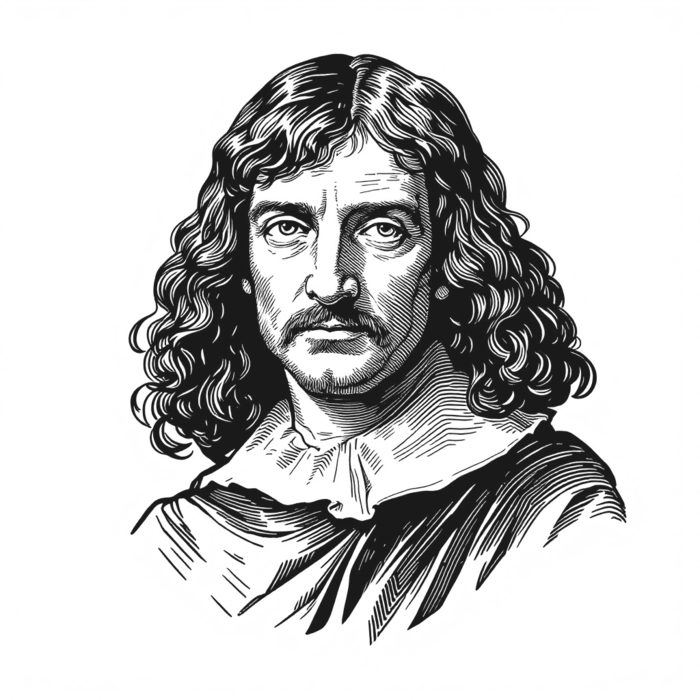
Rene Descartes

Rene Descartes

René Descartes (1596–1650) was a French philosopher, mathematician, and scientist who is often called the father of modern Western philosophy. His approach of systematic doubt—questioning everything that could possibly be doubted in order to arrive at indubitable truths—marked a revolutionary break with the Scholastic tradition. This method led him to his famous conclusion "Cogito, ergo sum" ("I think, therefore I am"), which he established as the one certainty that survives radical skepticism. From this foundation he attempted to rebuild knowledge using reason alone. In his Meditations on First Philosophy, he offered influential arguments for the existence of God and the distinction between mind and body, establishing a dualist framework that shaped philosophical debate for centuries. Descartes was equally significant as a mathematician: he invented the Cartesian coordinate system, which unified algebra and geometry, and laid essential groundwork for the development of calculus. His Discourse on the Method articulated principles for directing scientific inquiry that influenced the development of the scientific revolution. He spent much of his productive life in the Dutch Republic and died in Stockholm while serving as tutor to Queen Christina of Sweden.